

Showing posts with label food. Show all posts
Showing posts with label food. Show all posts
Monday, 1 April 2019
The 2019 Edition of Canada’s Food Guide: A Vegan Perspective
Hello everyone! I recently wrote a blog post that was published on the Vegan Society blog. The post is titled "The 2019 Edition of Canada's Food Guide: A Vegan Perspective". I hope you find it interesting!


Thursday, 22 November 2018
Moving Towards a Vegan Option in Canada
Hello everyone!
I wanted to give you all a quick update. You may
remember my two previous blog posts, letting you know about a petition
calling on the Canadian government “to require public canteens under federal
jurisdiction to provide a vegan option, and to raise this issue and work with
provincial and territorial counterparts to require the same at all levels of
government.” In practice, this means that a vegan option would be required to
be served in all public schools, hospitals, prisons, and other public
institutions. This is an important step that our country can take towards animal
rights and vegan rights. A similar law is already in place in Portugal.
I didn’t start the petition, but I signed it and mentioned
it on my blogs because this issue matters a lot to me.
In total, the petition received 3106 signatures from
the public, and it was presented to the House of Commons on February 7, 2018.
The government’s response was disappointing—basically, they implied that they
don’t plan on taking action on this issue.
Fortunately, however, the dedicated vegan advocates
who are working on this issue are not giving up! A new organization, Vegan
Option Canada, has been founded to advocate for this new law. Vegan Option
Canada is currently running two versions of their petition: an official paper
petition and an unofficial, supplementary online petition. You can sign both,
as the signatures for each petition are counted separately. You can access the
online petition directly by clicking here. Check out Vegan Option Canada’s website to learn more about this issue and to find a paper petition near you. Alternatively, you can order sheets
of the paper petition so that you can collect signatures yourself!
I feel quite confident that this initiative can
succeed. Let’s work together and make it happen!
 |
| Photo Courtesy of Suzette.nu. |
 |
| Whole Wheat Banana Muffins by Carolyn Harris. |
Thursday, 8 February 2018
Update on Petition Calling on Canadian Government to Provide Vegan Options at Public Canteens
Recently I received
an e-mail from the House of Commons Electronic Petitions website notifying me
that on February 7th, 2018, petition e-1205 was presented in the
House of Commons. The e-mail goes on to say, “You will be notified once a
government response has been tabled.”
This is a petition that I mentioned on my blog previously—it was calling on the federal government “to require public canteens under federal jurisdiction to provide a vegan option, and to raise this issue and work with provincial and territorial counterparts to require the same at all levels of government.” You can see the full text of the petition here, although it is no longer open to signatures.
This is a petition that I mentioned on my blog previously—it was calling on the federal government “to require public canteens under federal jurisdiction to provide a vegan option, and to raise this issue and work with provincial and territorial counterparts to require the same at all levels of government.” You can see the full text of the petition here, although it is no longer open to signatures.
On the House of Commons website, it is mentioned that this topic was brought up as well, but it doesn't say if or how anyone responded to it. You can see what I am talking about here.
I am
looking forward to seeing how the government responds. I will post on this blog
again to let you know how they responded once I receive further information on
the subject!
Thursday, 4 January 2018
Next Steps for the Revision of Canada's Food Guide
Happy New
Year, everyone!
From June 10, 2017 until July 25, 2017, the second phase of the online public consultation was held, in which Canadians could comment on some of the proposed dietary recommendations for the new Canada’s Food Guide. The proposed new Guiding Principles showed that Health Canada is planning on recommending that Canadians shift towards eating more plant-based foods. I wrote an in-depth blog post on the subject here.
Those of
you who have been following this blog for a while probably have heard that
Health Canada is currently in the process of revising Canada’s Food Guide, the
government-created resource that provides dietary recommendations to Canadians.
Now that
it’s 2018, I thought I would give a re-cap of what has happened so far in that
process and let you know what Health Canada is planning for the process in the
coming couple of years or so.
From October 24, 2016 to December 8, 2016, Health Canada held Phase 1 of the
online public consultation in which Canadians could share their views and
experiences about Canada’s Food Guide. During that time period, I wrote a blog
post entitled “Fixing the Problems on Canada’s Food Guide”,
in which I discussed why and how Canada’s Food Guide needs to change. I also
included my response to a question on the survey that I completed for the first
stage of the online consultation. Additionally, I had an Op-Ed published on the
Epoch Times website called “Health Canada Should Recommend a Vegan Diet”.
From June 10, 2017 until July 25, 2017, the second phase of the online public consultation was held, in which Canadians could comment on some of the proposed dietary recommendations for the new Canada’s Food Guide. The proposed new Guiding Principles showed that Health Canada is planning on recommending that Canadians shift towards eating more plant-based foods. I wrote an in-depth blog post on the subject here.
The
Government of Canada has also held some focus groups amongst Canadians to learn
more about how they use the dietary recommendations. In one series of focus
groups, participants were presented with a series of proposed “foundational statements” that may be used in Health Canada's dietary recommendations and were asked to give their
feedback. The statements were as follows:
“Make it a habit to enjoy a
variety of nutritious foods and beverages each day. Many foods fit healthy
eating, choose those that you enjoy and that reflect your culture and
traditions.
§ Choose
mostly plant-based foods.
§ Eat
plenty of vegetables and fruit, whole grains and some protein foods, especially
those foods that come from plants.
§ Include
foods that have healthy fats.
§ Limit
processed and prepared foods high in sodium, sugars, or saturated fat. If you
choose these foods, eat them less often and in small amounts.
§ Cook
with foods that are lower in sodium, sugars and saturated fats.
§ Make
water your drink of choice.
– Replace sugary drinks with
water. (Option 1)
– Choose water instead of
sugary drinks. (Option 2)
– Avoid sugary drinks. (Option
3)
§ Plain
milk, unsweetened fortified plant-based or soy beverages can also be healthy
beverage choices.
Healthy eating is more than the
foods you eat. It is also about how, where, when and why you eat.
§ Be
mindful of your eating habits
– Enjoy your food.
– Take time to eat.
– Notice when you are hungry
and when you are full.
§ Plan.
Cook. Eat together.
– Plan what you eat.
– Cook more often.
– Eat with family and friends
often.
– Share your foods skills, food traditions and culture.”
It is encouraging to see that “plant-based foods” are
mentioned in the first statement on this list, as well as “foods that come from
plants” making an appearance in the second statement! Also notable is the
de-emphasis of milk (as compared to previous Canada’s Food Guides) and the
inclusion of dairy-free beverages. However, these things are not particularly surprising, as the previously-released proposed Guiding Principles already showed us that Health Canada is most likely going to recommend a shift towards more plant-based eating, anyway. Of course, I would like them to recommend
that Canadians eat a purely plant-based, whole-foods vegan diet. That being said, these
statements show a clear improvement over Canada's previous dietary recommendations, and that is something
to be happy about. There is still definite room for improvement, however.
According to the Government of Canada’s website, in 2018, they will release “Part 1 of the
new dietary guidance policy report for health professionals and policy makers,
which will consist of general healthy eating recommendations”, and “supporting
key messages and resources for Canadians”. In 2019, they will release “Part 2 of the new dietary guidance policy
report, which will consist of healthy eating patterns (recommended amounts and
types of foods)”, and “additional resources for Canadians”. It remains to be
seen what exactly these resources will be like, but I’ll be sure to report on
them for this blog once they come out!
Saturday, 21 October 2017
Petition to the Government of Canada Regarding Food Policy
Recently I
found out about a new petition that was posted on the Parliament of Canada’s E-petitions
website. The petition, which is being sponsored by Liberal MP Nathaniel
Erskine-Smith, is calling for all public canteens under federal jurisdiction to
serve a vegan option (and for the federal government to work with the provinces
and territories to implement this law at their levels, as well).
The main
part of the petition reads, “We, the undersigned, citizens of Canada, call upon
the Government of Canada to require public canteens under federal jurisdiction
to provide a vegan option, and to raise this issue and work with provincial and
territorial counterparts to require the same at all levels of government.”
Judging by
the way that the petition is worded, it sounds like, if the petition becomes
law, this could lead to hospitals, schools, universities, colleges, prisons,
and other public institutions to be required to serve a vegan option. This
would be a win for vegans, for, as a matter of human
rights, it is essential that vegans have access to vegan food. Furthermore, the law would help animals, as it would make it easier for more people to eat a vegan diet, and it could help to
indirectly raise awareness about veganism and to help people realize what vegan
food actually is.
In March
2017, Portugal passed a law requiring all public canteens (at hospitals,
schools, prisons, etc.) to serve a vegan option. Canada needs a law like this,
too!
Canadian
citizens are able to sign the petition and read more about it here. The
petition is open until November 29, 2017, at 2:32 p.m. EDT.
 |
| Photo copyright Carolyn H. |
Monday, 16 October 2017
Published on Elephant Journal website: "Healthy Vegan Breakfast Ideas to Start the Day off Right"
I recently wrote an article that has been published on the Elephant Journal website. The article is titled "Healthy Vegan Breakfast Ideas to Start the Day off Right"; I hope it helps encourage people to go vegan!
Saturday, 17 June 2017
Our Voices Are Being Heard!
Hello
everyone,
Fixing the Problems on Canada's Food Guide (my previous blog post)
Many of you
may recall that last year, Health Canada was holding Phase 1 of its public
consultation on revising Canada's Food Guide. Canadians were invited to
submit their opinions and experiences with the Food Guide using an online form
on www.foodguideconsultation.ca. (You can read the blog post that I wrote last
year on the subject here.) In total, 19,873 submissions were received (although
participants were able to make submissions more than once). Of those, 14,297
were from the general public, 5,096 were from professionals, and 461 were from
organizations. Now, several documents have been
released, including one reviewing the input that has been heard from the
Canadian public; an “Evidence review for dietary guidance”; and a proposed
description of “Guiding Principles, Recommendations, and Considerations” for
healthy eating.
These
documents are very encouraging for those of us who are working to spread the
vegan message! I am saving the best news for later on in
this blog post (under the subheading “Guiding Principles”), but I recommend
that you read the whole post to get a more complete picture of how the proposed
dietary recommendations relate to plant-based eating.
Public Input from Phase 1 of the Consultation
First, let’s
look at the document, “Canada’s Food Guide Consultation – Phase 1 What We Heard Report”.
Happily,
veganism, vegetarianism, and plant-based diets are mentioned in the document a
few times!
The document
can be found in full on the Government of Canada website. Below, I have included
7 excerpts from the document that mention veganism, vegetarianism, and related
issues.
1) When asked
how useful the current Four Food Groups were, participants expressed the
following: “Current food groupings (such as Vegetables and Fruit, Grain Products,
Milk and Alternatives, and Meat and Alternatives) were considered useful, to at
least "some extent", due to their simplicity, however less useful to
some because of their departure from the nutritional components, lack of
applicability to all circumstances and needs such as for a vegan or vegetarian
lifestyle or dietary restrictions.” (found
in Section 4.0)
2) “Other personal
interests in healthy eating recommendations that were mentioned by participants
include:
- improving the
health of all Canadians in general;
- having a
focus on dietary choices such as vegetarianism and veganism;
- managing food
intolerances/allergies;
- disease
management/managing health conditions, such as diabetes;
- concerns
about the environment or animal welfare;
- support for
educational study; or
- to aid their
own involvement in a social or community group related to personal
wellbeing, such as:
- a healthy
lifestyle
- fitness
- weight loss”
(found in Section 5.1)
3) “Participants were very positive about the prospect of revisions to
Canada's Food Guide. For some, the current format offers a simple way to
structure thinking about healthy eating and encourages Canadians to think about
healthy eating principles. Others felt that the current recommendations are
misleading and that revisions would be helpful to ensure the recommendations
are useful to a broader audience.” (found in Section 5.2)
4) “Generally, participants from the public, professionals and
organizations felt that dietary guidance should cover a broad range of needs.
Feedback received from contributors on potential content of the guidance
included:
·
more focus on audience specific recommendations,
particularly for those with lower incomes, elderly Canadians and children;
·
inclusion of guidance addressing a range of lifestyle choices/dietary
restrictions; and,
·
more details related to the nutrient requirements for
positive health outcomes, such as a focus on macronutrients and micronutrients
essential for health.
A few participants also commented on a need for broader changes to the food
industry beyond guidance materials to more specific policy changes to improve
the health of Canadians by limiting options that negatively affect human
health.” (found in Section 5.2)
5) “Many general public participants indicated that the current food
groupings were useful to them, to at least "some extent". They often
cited the simplicity of the groupings as a good foundation for building
awareness of healthy eating habits. Others felt the groupings were not useful
due to their:
- departure
from the nutritional components (micro and macro nutrients) in foods
essential for positive health outcomes; and
- lack of
ability to apply the groupings to all circumstances and needs, such as
for:
- vegan or
vegetarian lifestyles
- other
dietary restrictions” (found in
Section 5.4)
6) “A greater emphasis on (or de-emphasis of) certain foods
was recommended by participating professionals as a way to improve the
usefulness of the food groupings. For example, some contributors suggested this
could include:
·
a greater emphasis on vegetables, rather than
fruits; or
·
a de-emphasis of meat or milk” (found in Section 5.4)
7) “While there are mixed perspectives, both positive and
negative, on the value of Canada's Food Guide in its current format (including
the content and recommendations specifically), many general public and
professional/organizational participants agree that Canada's Food Guide may no
longer be reflective of the increasingly varied diets of Canadians today.
There are different, more varied food types on the tables of
Canadians than ever before, due to the rise of trends, such as:
·
community gardening;
·
gluten-free products;
·
an emphasis on whole foods and plant-based
diets; and
·
the greater variety of traditional cuisines of
Canada's multicultural population.
There is a call for healthy eating recommendations to be
expanded to:
·
reflect this greater variety;
·
provide a basis of scientific evidence;
·
provide more details to Canadians about the
foods they are consuming; and
·
create guidance to inform healthy eating
behaviours.” (Section 6.0)
It seems that the government is starting to hear the logic
of our movement. That’s not all the good news, however. There’s more!
"Evidence Review for Dietary Guidance"
The document “Evidence review for dietary guidance” does not
mention plant-based eating, vegetarian diets, or vegan diets. However, they did
make some comments about how some people are concerned about industry influence
on Canada's Food Guide:
“Another reported challenge was that there remains a
perception among some groups of consumers and organizations that food industry
representatives exerted influence on the development of the recommendations in
the Food Guide. This adversely affects the credibility of the guidance from a
scientific standpoint in the eyes of these stakeholders.” (Page 5 of the PDF)
I wouldn’t be surprised if concerns raised by vegans about
the influence of the meat, dairy, and egg industries on the Food Guide are part
of the reason why Health Canada makes this statement. I myself expressed this
concern in my Op-Ed on the Epoch Times’ website last year.
Guiding Principles
Health Canada has also released a document outlining the
proposed Guiding Principles, Recommendations, and Considerations for healthy
eating.
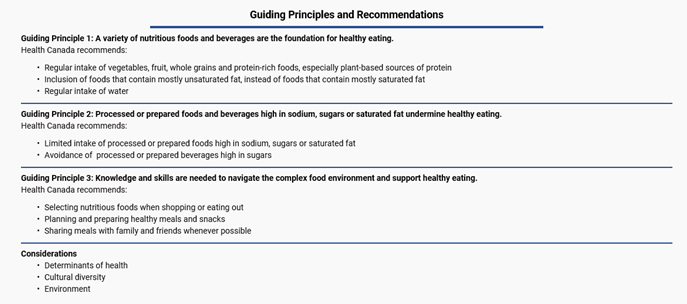
Here is a summarized description of the principles:
(Source: Government of Canada)
A detailed description of the Guiding Principles is also
available on the Government of Canada website. The word “plant-based” is used 6
times in the Guiding Principles document, and in 5 of those times it is used
positively! Here are 4 excerpts from the document that mention plant-based food:
1) “Health Canada recommends:
·
Regular intake of vegetables, fruit, whole
grains, and protein-rich foods* – especially plant-based sources of protein
·
Inclusion of foods that contain mostly
unsaturated fat, instead of foods that contain mostly of saturated fat
·
Regular intake of water
*Protein-rich foods include: legumes (such as beans), nuts
and seeds, soy products (including fortified soy beverage), eggs, fish and
other seafood, poultry, lean red meats (including game meats such as moose,
deer and caribou), lower fat milk and yogurt, cheeses lower in sodium and fat.
Nutritious foods that contain fat such as homogenized (3.25% M.F.) milk should
not be restricted for young children.”
Note that plant-based sources of protein are mentioned first on the list of protein-rich food
sources! It looks like the plant-based/vegan message is doing better
than many of us may have thought!
2) “What is needed is a shift towards a high proportion of
plant-based foods, without necessarily excluding animal foods altogether.”
While the second part of this sentence may initially seem a
bit disappointing, they do seem to be making progress in the right direction.
Also, consider the fact that Health Canada actually mentions the idea of
excluding animal products altogether; the way they phrase the sentence (“without
necessarily excluding” (italics added
by me)) makes me think that they don’t think that excluding animal products is
at all far-fetched.
3) “A shift towards more plant-based foods can help
Canadians:
·
eat more fibre-rich foods;
·
eat less red meat (beef, pork, lamb and goat);
and
·
replace foods that contain mostly saturated fat
(e.g., cream, high fat cheeses and butter) with foods that contain mostly
unsaturated fat (e.g., nuts, seeds, and avocado).
To help meet these recommendations, Canadians can choose
nutritious foods and beverages, including:
·
foods and beverages that require little or no
preparation such as fresh, frozen and canned vegetables and fruit, canned
legumes or fish, tofu, plain milk or fortified plant-based beverages;
·
foods and beverages that are pre-packaged for
convenience (such as pre-washed salad greens, pre-cut fruit) or to increase
shelf-life (such as powdered milk);
·
foods like nuts, seeds, fatty fish, avocado, and
vegetable oils instead of foods like high fat cheeses and cream; and
·
foods obtained through gardening, hunting,
trapping, fishing and harvesting.”
Apart from the last bullet point and the recommendations of fish
and milk, and, I am encouraged by with the progressive thinking in terms of
plant-based eating that is demonstrated here.
4) “In general, diets higher in plant-based foods and lower
in animal-based foods are associated with a lesser environmental impact, when
compared to current diets high in sodium, sugars and saturated fat.”
Overall, I am quite impressed with the receptiveness to
vegan and plant-based eating that the government has shown in this
first phase of the consultation. However, there is still definite room for
improvement.
Next Steps
Our job is not over yet!
Phase 2 of the public consultation is being held from June
10 untilJuly 25, 2017. In this new phase, Canadians are being asked to submit
their input on the proposed Guiding Principles for healthy eating.
I have already submitted my input. Although I did suggest
that plant-based eating be further emphasized (and that meat, dairy and other
animal products be further de-emphasized), I chose to focus my comments on the
positive aspects of the proposed new recommendations, as they appear to be a
major improvement from the current Food Guide. I want to encourage the
government to keep the progress they have made, at the very least. It is likely
that many groups will be submitting their comments to the government on the
proposed recommendations, so it is important for vegans to
speak up and let the government know that we care about this issue.
You can submit your comments at www.foodguideconsultation.ca. Thank you for caring!
Links:
Guiding PrinciplesFriday, 23 December 2016
2017 Animal Rights and Vegan Conferences!
Every year,
several conferences and events for vegan/animal rights activists take place
across North America and around the world. These events can provide a forum for
activists to network, learn about issues and advocacy strategies, and be inspired
to make a difference! Below is a list of some of the animal-rights-related
conferences that will be held in 2017. Please note that this is not a complete
list, and, as I haven’t been to any of these events in previous years, I can’t
say which ones are the best/most worthwhile to attend!
 Animal Rights National Conference 2017: According to this conference’s website, the Animal
Rights National Conference is the largest and longest-running animal rights
gathering—the first one was held in 1981! It is organized by the Farm Animal Rights Movement (FARM). If you can go to only one conference
this year, consider making this the one you go to. Here’s what they say you can
expect:
Animal Rights National Conference 2017: According to this conference’s website, the Animal
Rights National Conference is the largest and longest-running animal rights
gathering—the first one was held in 1981! It is organized by the Farm Animal Rights Movement (FARM). If you can go to only one conference
this year, consider making this the one you go to. Here’s what they say you can
expect:
“The Animal Rights National Conference is designed for people who wish to improve their animal advocacy skills or simply to network with other animal activists. The Conference offers a number of educational and networking opportunities, including:
 Vegetarian SummerFest 2017: This is an annual vegan festival and conference. The 2016 conference was
jam-packed with world-renowned vegan speakers, cooking classes, fitness
classes, vendors, and more!
Vegetarian SummerFest 2017: This is an annual vegan festival and conference. The 2016 conference was
jam-packed with world-renowned vegan speakers, cooking classes, fitness
classes, vendors, and more!

 Conscious Eating 2017 Conference: This conference, hosted by
United Poultry Concerns and Berkeley Organization for Animal Advocacy, will
focus on the ethics of eating and the role that religions play in the issue of
animal liberation.
Conscious Eating 2017 Conference: This conference, hosted by
United Poultry Concerns and Berkeley Organization for Animal Advocacy, will
focus on the ethics of eating and the role that religions play in the issue of
animal liberation.
 Physicians Committee for Responsible Medicine "Food For Life" Training: Interested in getting certified by PCRM to teach healthy vegan cooking in your community? Anyone interested in this can register to attend the next training! This isn't a conference, but I've included it because vegan activists may be interested in it anyway.
There's also:

“The Animal Rights National Conference is designed for people who wish to improve their animal advocacy skills or simply to network with other animal activists. The Conference offers a number of educational and networking opportunities, including:
- Sessions on animal advocacy, organizing, tactics, and issues
- More than 100 speakers from 60 organizations
- Eyewitness reports on key campaigns
- 100+ free exhibits
- Video premieres
- Newcomer Orientation
- Nightly networking receptions
- Awards Banquet on Saturday evening
- Closing celebration on Sunday evening
- Post-conference protests on Monday”
When: August 3 – 6
Where: Alexandria,
Vermont (just outside of Washington, DC), USA
Pre-registration opens: January 2017
 Vegetarian SummerFest 2017: This is an annual vegan festival and conference. The 2016 conference was
jam-packed with world-renowned vegan speakers, cooking classes, fitness
classes, vendors, and more!
Vegetarian SummerFest 2017: This is an annual vegan festival and conference. The 2016 conference was
jam-packed with world-renowned vegan speakers, cooking classes, fitness
classes, vendors, and more!
When: July 5-9, 2017
Where: last year it took place in Pennsylvania.
International Animal Rights Conference: This conference took place in Luxembourg in September 2016.
Their website does not yet mention if there is going to be a 2017 conference,
but I speculate it is likely that there will be, as they have had six of these
conferences to date.
 Conscious Eating 2017 Conference: This conference, hosted by
United Poultry Concerns and Berkeley Organization for Animal Advocacy, will
focus on the ethics of eating and the role that religions play in the issue of
animal liberation.
Conscious Eating 2017 Conference: This conference, hosted by
United Poultry Concerns and Berkeley Organization for Animal Advocacy, will
focus on the ethics of eating and the role that religions play in the issue of
animal liberation.
When: Saturday, March 11, 2017, 10am-6pm
Where: Berkeley,
California, USA
Cost: $15/person (free
for students)
The Anti-Fur Society Vegan Conference: This conference is focused on promoting vegan alternatives to
fur in clothing.
When: Saturday, April
8, 2017
Where: Manhattan, New
York, USA
 Physicians Committee for Responsible Medicine "Food For Life" Training: Interested in getting certified by PCRM to teach healthy vegan cooking in your community? Anyone interested in this can register to attend the next training! This isn't a conference, but I've included it because vegan activists may be interested in it anyway.
When: Wednesday, May 3 - Friday, May 5, 2017
Where: Washington, DC, USA
Your local VegFest: Don't forget to find out when your local VegFest will be taking place this year!
There's also:
- The Animal Film Festival on February 25, 2017 in California
- The World Vegan Summit (date not yet announced) in the USA (I cannot confirm that there will be one in 2017, but it sounds like there will be)
- Animals and Social Change Conference from June 29 - June 30, 2017 in Liverpool, UK
- Conference on Animal Rights in Europe, which took place in 2016 in Warsaw, Poland (I don't know if there will be a follow-up conference to this)
- Animal Activists Forum 2017 in October 2017 in Melbourne, Victoria, Australia
- Vevolution Festival 2017 (date not yet announced) in London, England
There is also an animal welfare conference taking place in Ottawa, ON, Canada in 2017. It doesn't look like it's related to animal rights at all, but if you live in Ottawa, it might be good to bring your vegan voice to that conference, to raise awareness!
The events that I've listed above are the ones that I believe are the most relevant, but you can find a list of some other events at All-Creatures.org, and a list of some major vegan festivals at Vegan.com.
Wednesday, 9 November 2016
Fixing the Problems on Canada's Food Guide
Some of you may remember the blog post I wrote for the NCVA blog a little while ago, on teaching kids about healthy vegan nutrition. In that post, I mentioned how the dietary recommendations of Canada's Food Guide were influenced by the dairy, meat, and egg industries, according to this CBC article. For example, the 2003 version of the Food Guide was revised by a panel that included food industry lobby groups. More shockingly, when the 1992 revision of Canada’s Food Guide was released, the meat, dairy, and egg industries successfully lobbied the government to increase the recommended number of servings of these products, according to the CBC article. You can see the effect that these lobby groups had on the government-endorsed dietary recommendations in the article "Canada's Food Guides from 1942 to 1992" on the Government of Canada's website-- in 1982, the Food Guide had 2 servings of "Meat and Alternatives" and 2 servings of "Milk"; but in 1992, these numbers increased to 2-3 servings of "Meat and alternatives" and 2-4 servings of "Milk". These new, increased recommendations continue to exist on the most recent Food Guide to date.
Canada's current Food Guide consists of four food groups: Vegetables and Fruit, Grain Products, Milk and Alternatives, and Meat and Alternatives. In school, children are taught that the recommendations on the Food Guide comprise the fundamentals of a healthy diet. Growing up, I, too, assumed that the Food Guide was based upon scientific fact. More recently, however, science has been finding something different: meat, dairy, and eggs actually increase the risk of many chronic diseases, while a vegan diet is a very healthy way to eat and can prevent certain diseases.
Although many vegan activists are already spreading the message about the healthfulness of veganism, it isn't just activists who are willing to point out the health benefits of an animal-free diet. Here are some statements on veganism and plant-based diets from just a few high-profile organizations around the world:
Click on the image to see it in full-size!

When one combines the health, environmental, humanitarian, and, of course, animal-related reasons to live vegan, it becomes obvious that the government ought to start supporting it, too!
So, why am I telling you all this? Well, Health Canada is now working on its next revision of Canada's Food Guide. From October 24, 2016 to December 8, 2016, Health Canada is holding an online public consultation on the Food Guide to get the public's input; all Canadians are welcome to submit their opinions through the Government of Canada's website.
In Mid-2017, the government will present a revised version of the Food Guide to the public, at which time Canadians will have another opportunity to provide their feedback on the revisions. After that, the new materials will be published.
I've already completed the questionnaire. On one page of the questionnaire, I was asked whether I find the current four food groupings in the Canada Food Guide helpful. I clicked "no", and then a box came up asking, "Why do you say that?"
Here was my response:
"I don't bother using the Food Guide, because the current recommendations simply doesn't apply to vegans like myself. The Food Guides' current food groupings are actually promoting ill health among Canadians. Furthermore, the current Four Food Groups are not at all accommodating for vegans and others who follow a dairy-free diet.
Dairy is not essential to the human diet. Although it is the perfect food for baby cows, it simply was not designed for human consumption. Some may claim that dairy is healthful because it contains calcium and protein, but the fact is, there are plenty of healthier plant-based sources of protein and calcium available. According to the Dieticians of Canada, calcium can be found in abundance in leafy green vegetables, fortified soy products, tahini (sesame seed butter), and many more vegan foods; protein can be obtained from soy products, beans, grains, nuts, and nut butters, to name a few.
According to the Dieticians of Canada, “A healthy vegan diet has many health benefits including lower rates of obesity, heart disease, high blood pressure, high blood cholesterol, type 2 diabetes and certain types of cancer.” (Source: http://www.dietitians.ca/Your-Health/Nutrition-A-Z/Vegetarian-Diets/Eating-Guidelines-for-Vegans.aspx)
I would like to propose 4 new food groups: Fruits, Vegetables, Grains, and Legumes/Nuts. The latter category combines the current two food groups of “Dairy and Alternatives” and “Meat and Alternatives” into an overall “Plant-based Protein” food group. The Physicians’ Committee for Responsible Medicine, an organization of medical doctors in the United States, also promotes this idea (Source: http://www.pcrm.org/health/diets/vsk/vegetarian-starter-kit-new-four-food-groups).
I hope that Health Canada can start promoting healthy eating in the ways I’ve mentioned above. I also hope that Health Canada can specifically mention the word “veganism” as a healthy diet on the Food Guide itself."
I also gave more information, such as statistics on the environmental benefits of veganism, in response to another one of their questions.
In addition, one thing that Health Canada seems to be focusing on in this revision of the Food Guide is reducing sugar consumption. If you are going to be filling out this survey, you may wish to point out that dairy products are actually quite high in sugar-- for example, there are 13g of sugar in one cup of 1% M.F. cow's milk.
That being said, we must not hesitate to voice our ethical views about veganism-- if Health Canada is aware that people are vegan for ethical reasons, they may be more likely to accommodate vegans in their next version of the food guide.
If you believe that veganism should be better represented and promoted on the Food Guide, please consider taking a few minutes out of your day to fill out the questionnaire. Feel free to copy and paste the quotations from the organizations I've listed above in your responses.
Thank you for believing that we can create a healthier, kinder, and more sustainable world.
Canada's current Food Guide consists of four food groups: Vegetables and Fruit, Grain Products, Milk and Alternatives, and Meat and Alternatives. In school, children are taught that the recommendations on the Food Guide comprise the fundamentals of a healthy diet. Growing up, I, too, assumed that the Food Guide was based upon scientific fact. More recently, however, science has been finding something different: meat, dairy, and eggs actually increase the risk of many chronic diseases, while a vegan diet is a very healthy way to eat and can prevent certain diseases.
Although many vegan activists are already spreading the message about the healthfulness of veganism, it isn't just activists who are willing to point out the health benefits of an animal-free diet. Here are some statements on veganism and plant-based diets from just a few high-profile organizations around the world:
- Dietitians of Canada: "A healthy vegan diet has many health benefits including lower rates of obesity, heart disease, high blood pressure, high blood cholesterol, type 2 diabetes and certain types of cancer."
- American Dietetic Association: "It is the position of the American Dietetic Association that appropriately planned vegetarian diets, including total vegetarian or vegan diets, are healthful, nutritionally adequate, and may provide health benefits in the prevention and treatment of certain diseases."
- World Health Organization:
- "Specific recommendations for a healthy diet include: eating more fruit, vegetables, legumes, nuts and grains; cutting down on salt, sugar and fats. It is also advisable to choose unsaturated fats, instead of saturated fats and towards the elimination of trans-fatty acids."
- The WHO has declared some types of meats to be Group 1 carcinogens (right up there with cigarette smoking) and Group 2 carcinogens.
- According to a study conducted by students at the University of Oxford, if the world went vegan, millions of human lives would also be saved due to dramatic reduction in the incidence of chronic disease: "A global switch to diets that rely less on meat and more on fruit and vegetables could save up to 8 million lives by 2050, reduce greenhouse gas emissions by two thirds, and lead to healthcare-related savings and avoided climate damages of $1.5 trillion (US)... ...They found that adopting diets in line with global dietary guidelines could avoid 5.1 million deaths per year by 2050. Even greater benefits could come from vegetarian diets (avoiding 7.3 million deaths) and vegan diets (avoiding 8.1 million deaths)."
- British Dietetic Associaton: "Well planned vegetarian diets [including vegan diets, which they mentioned as a form of vegetarianism] can be nutritious and healthy. They are associated with lower risks of heart disease, high blood pressure, Type 2 diabetes, obesity, certain cancers and lower cholesterol levels."
- United Nations Environment Programme: "A substantial reduction of impacts would only be possible with a substantial worldwide diet change, away from animal products." (Found on page 82 of this document, or page 84 of the PDF)
Click on the image to see it in full-size!
When one combines the health, environmental, humanitarian, and, of course, animal-related reasons to live vegan, it becomes obvious that the government ought to start supporting it, too!
So, why am I telling you all this? Well, Health Canada is now working on its next revision of Canada's Food Guide. From October 24, 2016 to December 8, 2016, Health Canada is holding an online public consultation on the Food Guide to get the public's input; all Canadians are welcome to submit their opinions through the Government of Canada's website.
In Mid-2017, the government will present a revised version of the Food Guide to the public, at which time Canadians will have another opportunity to provide their feedback on the revisions. After that, the new materials will be published.
I've already completed the questionnaire. On one page of the questionnaire, I was asked whether I find the current four food groupings in the Canada Food Guide helpful. I clicked "no", and then a box came up asking, "Why do you say that?"
Here was my response:
"I don't bother using the Food Guide, because the current recommendations simply doesn't apply to vegans like myself. The Food Guides' current food groupings are actually promoting ill health among Canadians. Furthermore, the current Four Food Groups are not at all accommodating for vegans and others who follow a dairy-free diet.
Dairy is not essential to the human diet. Although it is the perfect food for baby cows, it simply was not designed for human consumption. Some may claim that dairy is healthful because it contains calcium and protein, but the fact is, there are plenty of healthier plant-based sources of protein and calcium available. According to the Dieticians of Canada, calcium can be found in abundance in leafy green vegetables, fortified soy products, tahini (sesame seed butter), and many more vegan foods; protein can be obtained from soy products, beans, grains, nuts, and nut butters, to name a few.
According to the Dieticians of Canada, “A healthy vegan diet has many health benefits including lower rates of obesity, heart disease, high blood pressure, high blood cholesterol, type 2 diabetes and certain types of cancer.” (Source: http://www.dietitians.ca/Your-Health/Nutrition-A-Z/Vegetarian-Diets/Eating-Guidelines-for-Vegans.aspx)
I would like to propose 4 new food groups: Fruits, Vegetables, Grains, and Legumes/Nuts. The latter category combines the current two food groups of “Dairy and Alternatives” and “Meat and Alternatives” into an overall “Plant-based Protein” food group. The Physicians’ Committee for Responsible Medicine, an organization of medical doctors in the United States, also promotes this idea (Source: http://www.pcrm.org/health/diets/vsk/vegetarian-starter-kit-new-four-food-groups).
I hope that Health Canada can start promoting healthy eating in the ways I’ve mentioned above. I also hope that Health Canada can specifically mention the word “veganism” as a healthy diet on the Food Guide itself."
I also gave more information, such as statistics on the environmental benefits of veganism, in response to another one of their questions.
In addition, one thing that Health Canada seems to be focusing on in this revision of the Food Guide is reducing sugar consumption. If you are going to be filling out this survey, you may wish to point out that dairy products are actually quite high in sugar-- for example, there are 13g of sugar in one cup of 1% M.F. cow's milk.
That being said, we must not hesitate to voice our ethical views about veganism-- if Health Canada is aware that people are vegan for ethical reasons, they may be more likely to accommodate vegans in their next version of the food guide.
If you believe that veganism should be better represented and promoted on the Food Guide, please consider taking a few minutes out of your day to fill out the questionnaire. Feel free to copy and paste the quotations from the organizations I've listed above in your responses.
Thank you for believing that we can create a healthier, kinder, and more sustainable world.
Thursday, 3 November 2016
Opinion Article: "Health Canada Should Recommend a Vegan Diet"
An opinion essay I wrote, titled "Health Canada Should Recommend a Vegan Diet", was published on the Epoch Times website yesterday-- you can find it on the Epoch Times website here.
Although the Epoch Times website makes it look like I wrote this Op-Ed on behalf of the National Capital Vegetarian Association, please note that I only wrote it as a representation of my own opinions.
A longer blog post on Canada's Food Guide is coming soon!
Although the Epoch Times website makes it look like I wrote this Op-Ed on behalf of the National Capital Vegetarian Association, please note that I only wrote it as a representation of my own opinions.
A longer blog post on Canada's Food Guide is coming soon!
 |
| Logo of the Epoch Times |
Subscribe to:
Posts (Atom)