
Monday, 16 October 2017
Published on Elephant Journal website: "Healthy Vegan Breakfast Ideas to Start the Day off Right"
I recently wrote an article that has been published on the Elephant Journal website. The article is titled "Healthy Vegan Breakfast Ideas to Start the Day off Right"; I hope it helps encourage people to go vegan!

Tuesday, 12 September 2017
Ethical Issues and Pets on CBC Radio One
This morning on a radio show called The Current on CBC Radio One, Anna Maria Tremonti interviewed Gary Francione, Stanley Coren, and Jessica Pierce about their differing views on the ethical issues surrounding pet ownership. Very interesting discussion-- you can listen to it and/or read the accompanying article here.
Have a nice day!
Have a nice day!
Tuesday, 18 July 2017
Public History Assignment: Ottawa Earthlings March 2016
By Carolyn Harris
Hello everyone!
I am
currently taking a public history course in university, and one of my
assignments is to write a blog post on a story, event, or object from my own
life that I feel is worth preserving in an online exhibit for future public
history students. The event that I have chosen is the 2016 Ottawa Earthlings
March!
 |
| Photo posted by Savannah Greene on Facebook (not taken by me). |
The event
On
September 3, 2016, I attended Ottawa’s first annual Earthlings March, which is
a peaceful protest that aims to raise awareness about animal rights issues and
to call for an end to animal exploitation. Earthlings Marches were started by the
animal liberation group Direct Action Everywhere (DxE) and have taken place in dozens of cities around the world—from Montreal to London, and from Tel Aviv to Kharkiv. The
idea behind using the word “Earthlings” is that all humans and animals are
sentient beings who live on the Earth together. Different species though we may
be, we all have the right to be free from abuse and exploitation. The word
“Earthlings” also is used by the documentary of the same name, which is about
the horrors of factory farming.
Ottawa’s march, which was organized by the Ottawa Animal Defense League, started with some speeches by Ottawa-based activists in front of dozens of participants who gathered in Confederation Park. Then, holding signs and chanting, we marched through downtown Ottawa, including past Parliament Hill and the Chateau Laurier. The march lasted for about an hour.
 |
| Photo by Carolyn Harris. |
 |
| Speeches before the march. Photo by Carolyn Harris. |
Our chants
These chants were presumably written by (an) animal rights activist(s) involved in the march (but not me).
Freedom for
all,
 |
| Photo by Carolyn Harris. |
Humans and
animals
We are all
equal
No more oppression,
Animal
liberation
For the
rabbits and the foxes and the mink and the pigs
No excuses
Let the
animals live!
For the
lambs and the cows and the birds and the fish
No excuses
Let the
animals live!
Not just for Cecil
Not just for Harambe
We want
justice for all animals!
Not just
for dogs, not just for cats, no
We want
justice for all animals!
Stop
exploitation
Meat
abolition
One struggle,
one fight
Human
freedom, animal rights
The march
certainly got a lot of attention from passersby, and some onlookers filmed us
with their phones as we walked by. Some march participants handed out leaflets
to passersby, and/or put animal rights stickers on telephone poles along the
route.
Why does
this story need to be remembered?
Amazingly, even
though dozens of us were there (and we made a lot of noise, believe me!), there
was absolutely no coverage of the march by mainstream media. A quick Google search done months later reveals that the only online documentation of what
happened at this event is on Facebook, in one YouTube video (published by one
of the activists who was there), and on my vegan advocacy blog in a previous post.
Despite the
lack of interest by the media, this story is one that needs to be remembered.
The 2016 Ottawa Earthlings March is significant because it was the first of its
kind in Ottawa, and furthermore, it is representative of the modern animal
rights/vegan movement in 2016-2017. The movement has been changing its message
to demand an end to the slaughter (instead of merely suggesting that animals have rights), and it is increasing in its
reach like never before. Veganism is becoming more mainstream through increased
vegan food selection in grocery stores and celebrity figures adopting a vegan
diet. It is quite likely that in fifty years’ time, mainstream Canadian society
will see animal rights as an important social justice issue.
 |
| Did you know...? |
The fact
is, the history of the animal rights/vegan movement is rarely told in museums
and exhibits around the world. But as the author of my public history textbook
points out, when repositories accept contributions from the public, this can
“allow repositories to ‘actively document those whose voices have been
overlooked or marginalized’ (SAA 2011). Public engagement might contribute to
limiting historical silences in collections” (Cauvin 46).
Through documentation,
the memory of this event will not fade into oblivion quite as quickly as it otherwise would,
and with luck, future historians will give it attention when they are writing
the history of the animal rights movement/the history of Ottawa.
Canada 150
and Canada’s national identity
When
talking about Canada’s national identity, animal rights and veganism do not
usually come to most people’s minds. But, although vegans and
animal rights activists are still the minority in Canada, our stories are nevertheless
worthy of being told.
Besides, I maintain
that the animal rights movement is already in line with Canadian values. Canada
generally stands for respecting others’ right to live and be free. When one
considers the sentience of non-human animals, it becomes apparent that we must
respect animals’ rights, too.
 |
| Walking past Parliament Hill. Photo by Carolyn Harris. |
Closing
thoughts
Most
importantly, this story needs to be remembered for the billions of animals who
are killed every year for human tastes and profit. When we remember this march,
we are also remembering the animals.
(Please note: The first and the last photos in this blog post were downloaded from someone else's post on this event's Facebook Event page. All the other photos are Copyright Carolyn Harris 2016.)
 |
| Photo posted by Savannah Greene on Facebook (not taken by me). |
Saturday, 17 June 2017
Our Voices Are Being Heard!
Hello
everyone,
Fixing the Problems on Canada's Food Guide (my previous blog post)
Many of you
may recall that last year, Health Canada was holding Phase 1 of its public
consultation on revising Canada's Food Guide. Canadians were invited to
submit their opinions and experiences with the Food Guide using an online form
on www.foodguideconsultation.ca. (You can read the blog post that I wrote last
year on the subject here.) In total, 19,873 submissions were received (although
participants were able to make submissions more than once). Of those, 14,297
were from the general public, 5,096 were from professionals, and 461 were from
organizations. Now, several documents have been
released, including one reviewing the input that has been heard from the
Canadian public; an “Evidence review for dietary guidance”; and a proposed
description of “Guiding Principles, Recommendations, and Considerations” for
healthy eating.
These
documents are very encouraging for those of us who are working to spread the
vegan message! I am saving the best news for later on in
this blog post (under the subheading “Guiding Principles”), but I recommend
that you read the whole post to get a more complete picture of how the proposed
dietary recommendations relate to plant-based eating.
Public Input from Phase 1 of the Consultation
First, let’s
look at the document, “Canada’s Food Guide Consultation – Phase 1 What We Heard Report”.
Happily,
veganism, vegetarianism, and plant-based diets are mentioned in the document a
few times!
The document
can be found in full on the Government of Canada website. Below, I have included
7 excerpts from the document that mention veganism, vegetarianism, and related
issues.
1) When asked
how useful the current Four Food Groups were, participants expressed the
following: “Current food groupings (such as Vegetables and Fruit, Grain Products,
Milk and Alternatives, and Meat and Alternatives) were considered useful, to at
least "some extent", due to their simplicity, however less useful to
some because of their departure from the nutritional components, lack of
applicability to all circumstances and needs such as for a vegan or vegetarian
lifestyle or dietary restrictions.” (found
in Section 4.0)
2) “Other personal
interests in healthy eating recommendations that were mentioned by participants
include:
- improving the
health of all Canadians in general;
- having a
focus on dietary choices such as vegetarianism and veganism;
- managing food
intolerances/allergies;
- disease
management/managing health conditions, such as diabetes;
- concerns
about the environment or animal welfare;
- support for
educational study; or
- to aid their
own involvement in a social or community group related to personal
wellbeing, such as:
- a healthy
lifestyle
- fitness
- weight loss”
(found in Section 5.1)
3) “Participants were very positive about the prospect of revisions to
Canada's Food Guide. For some, the current format offers a simple way to
structure thinking about healthy eating and encourages Canadians to think about
healthy eating principles. Others felt that the current recommendations are
misleading and that revisions would be helpful to ensure the recommendations
are useful to a broader audience.” (found in Section 5.2)
4) “Generally, participants from the public, professionals and
organizations felt that dietary guidance should cover a broad range of needs.
Feedback received from contributors on potential content of the guidance
included:
·
more focus on audience specific recommendations,
particularly for those with lower incomes, elderly Canadians and children;
·
inclusion of guidance addressing a range of lifestyle choices/dietary
restrictions; and,
·
more details related to the nutrient requirements for
positive health outcomes, such as a focus on macronutrients and micronutrients
essential for health.
A few participants also commented on a need for broader changes to the food
industry beyond guidance materials to more specific policy changes to improve
the health of Canadians by limiting options that negatively affect human
health.” (found in Section 5.2)
5) “Many general public participants indicated that the current food
groupings were useful to them, to at least "some extent". They often
cited the simplicity of the groupings as a good foundation for building
awareness of healthy eating habits. Others felt the groupings were not useful
due to their:
- departure
from the nutritional components (micro and macro nutrients) in foods
essential for positive health outcomes; and
- lack of
ability to apply the groupings to all circumstances and needs, such as
for:
- vegan or
vegetarian lifestyles
- other
dietary restrictions” (found in
Section 5.4)
6) “A greater emphasis on (or de-emphasis of) certain foods
was recommended by participating professionals as a way to improve the
usefulness of the food groupings. For example, some contributors suggested this
could include:
·
a greater emphasis on vegetables, rather than
fruits; or
·
a de-emphasis of meat or milk” (found in Section 5.4)
7) “While there are mixed perspectives, both positive and
negative, on the value of Canada's Food Guide in its current format (including
the content and recommendations specifically), many general public and
professional/organizational participants agree that Canada's Food Guide may no
longer be reflective of the increasingly varied diets of Canadians today.
There are different, more varied food types on the tables of
Canadians than ever before, due to the rise of trends, such as:
·
community gardening;
·
gluten-free products;
·
an emphasis on whole foods and plant-based
diets; and
·
the greater variety of traditional cuisines of
Canada's multicultural population.
There is a call for healthy eating recommendations to be
expanded to:
·
reflect this greater variety;
·
provide a basis of scientific evidence;
·
provide more details to Canadians about the
foods they are consuming; and
·
create guidance to inform healthy eating
behaviours.” (Section 6.0)
It seems that the government is starting to hear the logic
of our movement. That’s not all the good news, however. There’s more!
"Evidence Review for Dietary Guidance"
The document “Evidence review for dietary guidance” does not
mention plant-based eating, vegetarian diets, or vegan diets. However, they did
make some comments about how some people are concerned about industry influence
on Canada's Food Guide:
“Another reported challenge was that there remains a
perception among some groups of consumers and organizations that food industry
representatives exerted influence on the development of the recommendations in
the Food Guide. This adversely affects the credibility of the guidance from a
scientific standpoint in the eyes of these stakeholders.” (Page 5 of the PDF)
I wouldn’t be surprised if concerns raised by vegans about
the influence of the meat, dairy, and egg industries on the Food Guide are part
of the reason why Health Canada makes this statement. I myself expressed this
concern in my Op-Ed on the Epoch Times’ website last year.
Guiding Principles
Health Canada has also released a document outlining the
proposed Guiding Principles, Recommendations, and Considerations for healthy
eating.
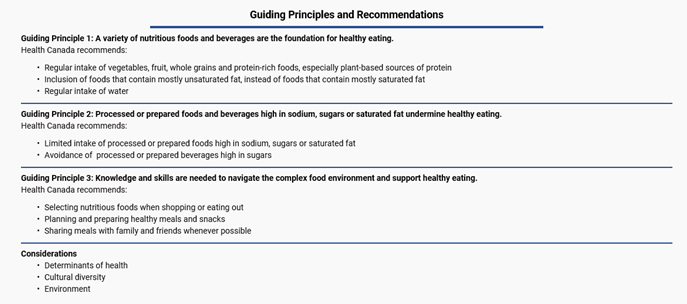
Here is a summarized description of the principles:
(Source: Government of Canada)
A detailed description of the Guiding Principles is also
available on the Government of Canada website. The word “plant-based” is used 6
times in the Guiding Principles document, and in 5 of those times it is used
positively! Here are 4 excerpts from the document that mention plant-based food:
1) “Health Canada recommends:
·
Regular intake of vegetables, fruit, whole
grains, and protein-rich foods* – especially plant-based sources of protein
·
Inclusion of foods that contain mostly
unsaturated fat, instead of foods that contain mostly of saturated fat
·
Regular intake of water
*Protein-rich foods include: legumes (such as beans), nuts
and seeds, soy products (including fortified soy beverage), eggs, fish and
other seafood, poultry, lean red meats (including game meats such as moose,
deer and caribou), lower fat milk and yogurt, cheeses lower in sodium and fat.
Nutritious foods that contain fat such as homogenized (3.25% M.F.) milk should
not be restricted for young children.”
Note that plant-based sources of protein are mentioned first on the list of protein-rich food
sources! It looks like the plant-based/vegan message is doing better
than many of us may have thought!
2) “What is needed is a shift towards a high proportion of
plant-based foods, without necessarily excluding animal foods altogether.”
While the second part of this sentence may initially seem a
bit disappointing, they do seem to be making progress in the right direction.
Also, consider the fact that Health Canada actually mentions the idea of
excluding animal products altogether; the way they phrase the sentence (“without
necessarily excluding” (italics added
by me)) makes me think that they don’t think that excluding animal products is
at all far-fetched.
3) “A shift towards more plant-based foods can help
Canadians:
·
eat more fibre-rich foods;
·
eat less red meat (beef, pork, lamb and goat);
and
·
replace foods that contain mostly saturated fat
(e.g., cream, high fat cheeses and butter) with foods that contain mostly
unsaturated fat (e.g., nuts, seeds, and avocado).
To help meet these recommendations, Canadians can choose
nutritious foods and beverages, including:
·
foods and beverages that require little or no
preparation such as fresh, frozen and canned vegetables and fruit, canned
legumes or fish, tofu, plain milk or fortified plant-based beverages;
·
foods and beverages that are pre-packaged for
convenience (such as pre-washed salad greens, pre-cut fruit) or to increase
shelf-life (such as powdered milk);
·
foods like nuts, seeds, fatty fish, avocado, and
vegetable oils instead of foods like high fat cheeses and cream; and
·
foods obtained through gardening, hunting,
trapping, fishing and harvesting.”
Apart from the last bullet point and the recommendations of fish
and milk, and, I am encouraged by with the progressive thinking in terms of
plant-based eating that is demonstrated here.
4) “In general, diets higher in plant-based foods and lower
in animal-based foods are associated with a lesser environmental impact, when
compared to current diets high in sodium, sugars and saturated fat.”
Overall, I am quite impressed with the receptiveness to
vegan and plant-based eating that the government has shown in this
first phase of the consultation. However, there is still definite room for
improvement.
Next Steps
Our job is not over yet!
Phase 2 of the public consultation is being held from June
10 untilJuly 25, 2017. In this new phase, Canadians are being asked to submit
their input on the proposed Guiding Principles for healthy eating.
I have already submitted my input. Although I did suggest
that plant-based eating be further emphasized (and that meat, dairy and other
animal products be further de-emphasized), I chose to focus my comments on the
positive aspects of the proposed new recommendations, as they appear to be a
major improvement from the current Food Guide. I want to encourage the
government to keep the progress they have made, at the very least. It is likely
that many groups will be submitting their comments to the government on the
proposed recommendations, so it is important for vegans to
speak up and let the government know that we care about this issue.
You can submit your comments at www.foodguideconsultation.ca. Thank you for caring!
Links:
Guiding PrinciplesMonday, 27 March 2017
6 Ways to Distribute Vegan/Animal Rights Literature (besides leafleting)
Leafleting is a good way to get the vegan/animal rights message to people who otherwise might not see it. However, to those vegans who might not want to stand on a street corner and hand out literature to strangers, there are still other ways you can spread vegan/animal rights literature! Here are some ideas (in some cases, you may need to ask permission before setting out the literature, but it depends on the location where you are putting it):
1. Place some brochures for your local vegan association, or some Vegan Starter Kit booklets, in the rack of free magazines and newspapers at your local grocery store. When people are grocery shopping, they are already thinking about food, and will probably be more likely to pick up a vegan starter guide than they would be at other times.
2. Place some leaflets, booklets, or brochures around your school or at your workplace.
3. Go to your local health food stores, eco-friendly stores, and other like-minded shops and ask if they will set out brochures for your local vegan association at the cash register. Now that veganism is becoming increasingly mainstream, you may find them very willing—or even eager—to see your literature!
4. Stop by the local library or community centre and ask if they will set out the literature.
5. Put up “Go Vegan” posters on telephone poles around your city.
6. Bring booklets, leaflets, and other literature with you when you go out—you never know when you’ll run into someone who might want some vegan/animal rights information!
Wednesday, 22 February 2017
Ten Things You Can Do To Help Animals Today
- Print out posters advocating for veganism, and put them up on telephone poles and public bulletin boards around your city or University campus. Make sure to be aware of your local postering laws first! You can find printable posters online, or make your own, or order some from an animal rights organization.
- Order some leaflets promoting veganism (or print them off your computer-- have you seen the ones I've designed?). Once you have your leaflets, hand them out to passersby on a busy street corner!
- Write a letter to a local grocery store, restaurant, or cafeteria asking them for more vegan options. Remember to give them specific examples of vegan foods that will be used instead of animal products! One thing you could ask for is the new VeganEgg, for example.
- Bake vegan treats and give them to your co-workers, classmates, friends, and/or family. Don't forget to tell them that it's vegan!
- Order some animal rights stickers to stick on your laptop, wallet, or water bottle.* When you take these items into a public place, people who see them will be reminded of the animal rights and vegan ethic.
- Write a Letter to the Editor or an Op-Ed on a recent vegan-related or animal-related issue, particularly if it's something about which the newspaper has recently published a story. Even if your letter doesn't get published, the newspaper staff will still see it and may be influenced by your message in some way.
- Get some sidewalk chalk and write pro-vegan messages on the pavement outside (in places where it's legal to do so, of course). Bonus: if you take a photograph of your chalk creation, you can send it in to Vegan Chalk Challenge and they'll post it on their Facebook Page!
- Put together a little booklet of your favourite vegan recipes to give to family and friends. Alternatively, you could make the recipes into an e-book, and then send the e-book to people by e-mail and/or post it on Facebook! Bonus: include photographs of the foods in your booklet!
- Send a nice note or e-mail to your favourite vegan activists to thank them for the work they do. A thank-you letter can really make someone's day, and encourage them to keep working for animal rights.
- The ideas I've given above are just a few ways to inject some activism into your everyday life, but there are also more long-term projects that you can do to help animals. If you have the time and energy for long-term activist projects, why not take some time out of your day today to brainstorm about how to combine your talents, skills, and interests for animal rights? For example, you may wish to start a blog, host a podcast, give presentations at local schools, write a book, start a vegan business or organization, or run vegan cooking classes.


If you're really keen to dive into animal rights activism, you could try doing one of these things every day for ten days! Or, just pick and choose from this list whichever activities you'd like to try. Thank you for working to create a kinder, and more just, world.
Saturday, 4 February 2017
The February Issue of "alive" Magazine is About Being Vegan!
Alive magazine is a Canadian magazine that is supported in part by the Natural Health Products industry. It is available for free in health food stores across Canada, and I used to read it.
I stopped reading alive magazine about a year ago, as I found it disturbing that they had so many animal products in their recipes.
However, today I went to my local health food store and saw the latest issue of alive on the counter. I was pleasantly surprised to discover that this month's issue of alive is all about "Being Vegan"! The Guest Editor is Brendan Brazier, a vegan Ironman triathlete, author, and co-founder of the "Vega" health products. And so, for the first time in about a year, I picked up a new copy of the magazine.
Unfortunately, there are still non-vegan advertisements in this issue of the magazine, and I am not going to go back to reading their magazine on a regular basis unless they stop including dead animals in their recipes, but I find it heartening to see that veganism is entering the mainstream more and more.
This issue has tips about vegan substitutions when baking, provides lots of vegan recipes, and includes stories about vegans.

Keep speaking up for the animals, everyone-- I think the logic of veganism is being heard with a greater intensity every year. :)
I stopped reading alive magazine about a year ago, as I found it disturbing that they had so many animal products in their recipes.
However, today I went to my local health food store and saw the latest issue of alive on the counter. I was pleasantly surprised to discover that this month's issue of alive is all about "Being Vegan"! The Guest Editor is Brendan Brazier, a vegan Ironman triathlete, author, and co-founder of the "Vega" health products. And so, for the first time in about a year, I picked up a new copy of the magazine.
Unfortunately, there are still non-vegan advertisements in this issue of the magazine, and I am not going to go back to reading their magazine on a regular basis unless they stop including dead animals in their recipes, but I find it heartening to see that veganism is entering the mainstream more and more.
This issue has tips about vegan substitutions when baking, provides lots of vegan recipes, and includes stories about vegans.

Keep speaking up for the animals, everyone-- I think the logic of veganism is being heard with a greater intensity every year. :)
Wednesday, 11 January 2017
The Origins of the Word "Vegan"

Have you ever wondered how (and when) the word “vegan” came into existence?
With
veganism growing in popularity these days, some people might think that
veganism is a new invention, but in fact, vegetarianism has been practiced for
thousands of years; although we don’t know how many vegetarians in the ancient
times were vegans, we know for sure that veganism has been practiced since at
least the beginning of the 1800’s. The word “vegan” first appeared in 1944,
upon the founding of the Vegan Society in the United Kingdom.
The word
“vegetarian” (which I will discuss in another post) goes back to around the
1830’s. At this time in Britain, “vegetarian” meant essentially what we mean
when we say “vegan” today—that is, one who abstains from animal flesh, milk,
eggs, and all other animal products.
Upon the
founding of the Vegetarian Society in Great Britain in 1847, however, the
Vegetarian Society, in an effort to accommodate those of their members who still
consumed dairy and eggs, decided that a vegetarian diet would be defined as a
diet that excluded meat, but included milk and eggs. This became a point of
controversy within the Vegetarian Society, especially in the first half of the
1900’s.1 Eventually a group of “non-dairy vegetarians” suggested
that a section of the Vegetarian Society’s journal be devoted to a form of
vegetarianism that excludes all animal products. However, the committee of the
Vegetarian Society “decided that the full energies of the Society must continue
to be applied to the task of abolishing flesh-eating, and that any such Group
[of non-dairy vegetarians] would, therefore, be freer to act as an independent
body.”2
And so, in
November 1944, such a group was formed, although it didn’t have a name in the
beginning. The first issue of The Vegan
News (The Vegan Society’s original newsletter) was single-handedly written
and produced by Donald Watson, a teacher of woodwork and the secretary of a
local vegetarian society. On the second page of the newsletter, he wrote,
“WANTED—A NAME.
We should
all consider carefully what our Group, and our magazine, and ourselves, shall
be called. “Non-dairy” has become established as a generally understood
colloquialism, but like “non-lacto” it is too negative. Moreover it does not
imply that we are opposed to the use of eggs as food. We need a name that
suggests what we do eat. and if possible one that conveys the idea that even
with all animal foods taboo, Nature still offers us a bewildering assortment
from which to choose. “Vegetarian” and “Fruitarian” are already associated with
societies that allow the “fruits” (!) of cows and fowls, therefore it seems we
must make a new and appropriate word. As this first issue of our periodical had
to be named, I have used the title “The Vegan News”. Should we adopt this, our
diet will soon become known as a VEGAN diet, and we should aspire to the rank
of VEGANS. Member’s suggestions will be welcomed. The virtue of having a short
title is best known to those of us who, as secretaries of vegetarian societies
have to type or write the word vegetarian thousands of times a year!”2
In the second issue of The Vegan News, Watson noted that the word “Allvega” had been
suggested by members Mr. and Mrs. G. A. Henderson (and they had suggested
“Allvegan” as the title of the magazine). “It was from this that the word Vegan
was taken,” Watson wrote, “and recently Mr and Mrs Henderson have written
stating that they prefer the shorter version.”
The word “vega” had, indeed, already been used by
vegetarians prior to 1944. In a history of the Vegan Society written in 2014,
it is suggested that the Hendersons’ suggestion was inspired by a contemporary
vegetarian restaurant in London that was called the Vega. (The original Vega
restaurant had been in Cologne, Germany. After the owners had to flee from Germany,
they opened up their new restaurant in London.)1
Despite Watson’s preference for the word “vegan”, No.
2 of The Vegan News still included other
ideas from those who had written in with their own suggestions. One person
suggested that the society call itself “the Total Vegetarian Group (T.V.G.)”;
another said that the magazine could be called “The True Vegetarian”. For the
word that the non-dairy vegetarians would use to refer to themselves, the
following suggestions were made: Neo-vegetarians, Dairybans, Vitans, Benevores,
Sanivores, Beaumangeurs, or Bellevores, although these suggestions do not
appear to have been taken very seriously.
In an interview in 2004, Donald Watson said, “I
settled for my own word, "vegan", containing the first three and last
two letters of "vegetarian" -- "the beginning and end of
vegetarian." The word was accepted by the Oxford English Dictionary and no
one has tried to improve it.”4
It is also the second issue of The Vegan News that Watson clarified how the word vegan is pronounced: “Veegan, not
Veejan.”
By the time No. 3 of The Vegan News was published, the word “vegan” had truly been
adopted, as evidenced by the use of the name, “The Vegan Society”, at the top
of the front page; and by the following sentences, also found on the front
page:
“VEGANISM is the practice of living on fruits,
nuts, vegetables, grains, and other wholesome non-animal products.
VEGANISM excludes as human food: flesh, fish, fowl, eggs, honey;
and animals’ milk, butter, and cheese.
VEGANISM aims at encouraging the manufacture and use of alternatives
to animal products.”5
Later, the definition of veganism would be further
refined. The most current definition of Veganism—as defined by the Vegan Society—was
agreed upon in 1979. According to this definition, veganism is
"A philosophy and way of living which seeks to
exclude—as far as is possible and practicable—all forms of exploitation of, and
cruelty to, animals for food, clothing or any other purpose; and by extension,
promotes the development and use of animal-free alternatives for the benefit of
humans, animals and the environment. In dietary terms it denotes the practice
of dispensing with all products derived wholly or partly from animals."
Nowadays, in 2017, millions of people around the world
refer to themselves as vegans. May this just and compassionate way of life
continue to spread around the world!
Sources:
1. The Vegan Society, Ripened by Human Determination, 2014.
2. The Vegan
News, Number 1.
3. The Vegan
News, Number 2.
4. Vegetarians
in Paradise, “24 Carrot Award”. 11 August 2004. http://www.vegparadise.com/24carrot610.html
5. The Vegan
News, Number 3.
6. The Vegan Society, “Definition of veganism.” https://www.vegansociety.com/go-vegan/definition-veganism
Subscribe to:
Posts (Atom)